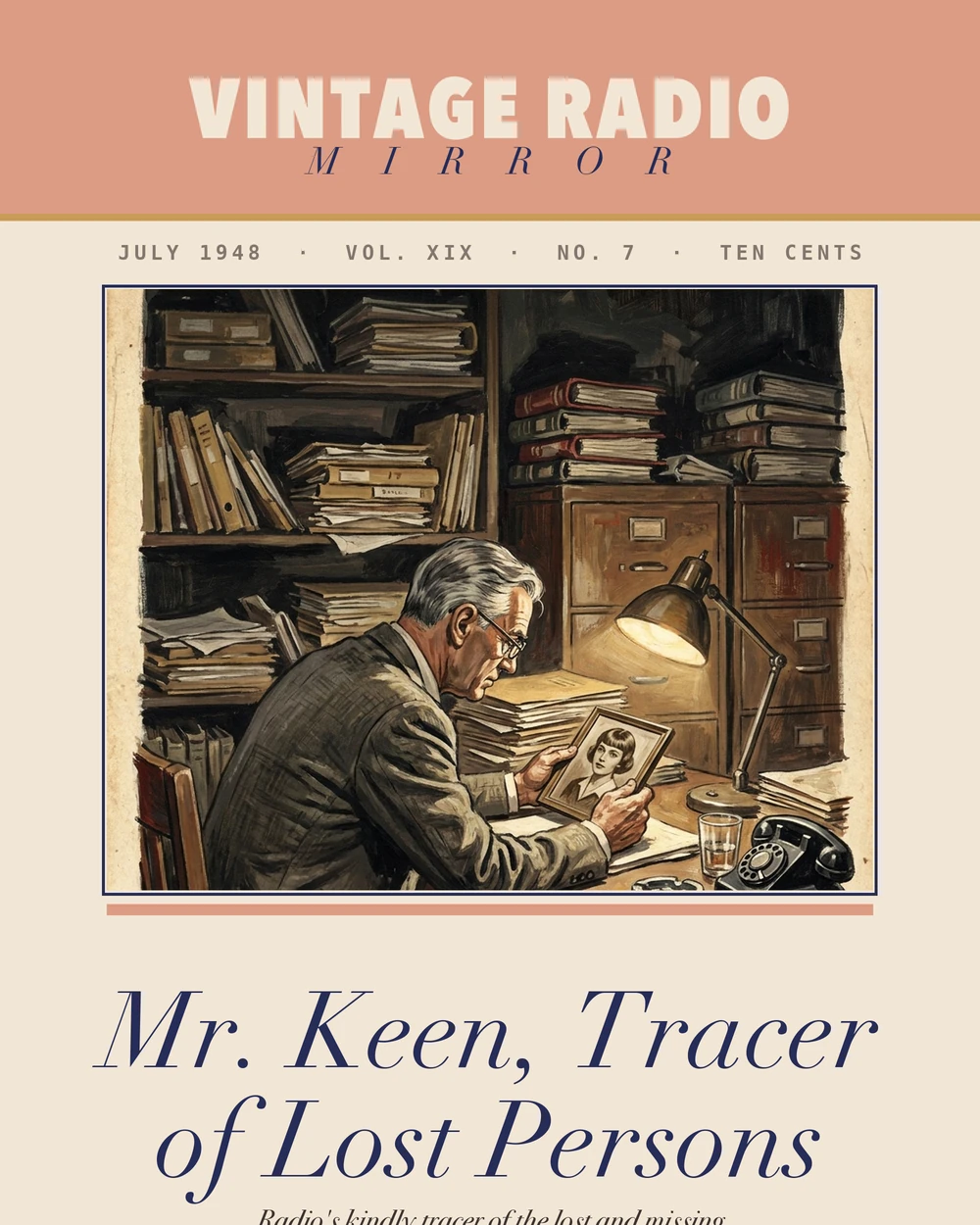
Mr. Keen – Tracer of Lost Persons
The Most Durable Detective on Radio
No private detective in radio history logged more air time than Mr. Keen. From his premiere on the Blue Network on October 12, 1937, through a finale that came sometime in 1955, the show produced 1,690 nationwide broadcasts across eighteen years. For comparison, Nick Carter, Master Detective managed 726 broadcasts, The Adventures of Sherlock Holmes reached 657, and The Adventures of the Falcon stopped at 473. Mr. Keen simply outlasted all of them — not because the show was particularly sophisticated, but because it had an audience that kept showing up, sponsors who kept paying for it, and a production operation disciplined enough to keep the assembly line running.
The show started as a 15-minute continuation serial airing three times a week on the Blue Network, sponsored by Bisodol. That format, running through October 1942, gave the show something most radio crime dramas never had: room to breathe. Multi-episode story arcs meant the plots didn't have to resolve in a single sitting, which gave the early Mr. Keen a degree of narrative credibility that the later half-hour format would largely abandon. In those early years, the character was presented as a genuine tracer of missing persons — a sage, careful investigator who actually lived up to his billing.
Where the Character Came From
The radio show drew its name and premise from a 1906 novel, The Tracer of Lost Persons, published by D. Appleton and Company. The author was Robert W. Chambers, an American novelist who eventually wrote more than seventy books. In Chambers' original conception, the detective was named Westrel Keen, running a missing-persons agency called Keen & Co. out of prime New York City office space. The character had actually appeared even earlier, in short stories published in The Saturday Evening Post beginning June 17, 1905, before the 1906 novel collected them.
The radio show kept the name and the general concept but steadily transformed the character. By the time the show expanded to a 30-minute weekly format on CBS starting December 2, 1943, Mr. Keen had stopped tracing lost persons almost entirely and become a murder investigator. The connection to Chambers' original premise had thinned to the title alone.
The Hummert Machine
Frank and Anne Hummert produced Mr. Keen, and understanding how the Hummerts worked goes a long way toward explaining what the show sounded like. Radio historian Jim Cox, in his 2003 book Frank and Anne Hummert's Radio Factory (McFarland), described their operation as "the General Motors of radio." By the 1940s, the Hummerts' company, Air Features, Inc. — which they spun off in 1943 when their original agency reorganized — controlled four and a half hours of the national weekday broadcast schedule.
The dialogue was officially attributed to Frank Hummert but was actually written under his supervision by a staff of dialoguers that included Lawrence Klee, Bob Shaw, Barbara Bates, Stedman Coles, Charles J. Gussman, and David Davidson. The Hummert method had writers produce outlines, then assigned dialoguers to flesh out the scripts — a system that kept labor costs down. Writers sometimes accepted these assignments as supplementary income, what some called "caviar money." Richard Leonard directed, Al Rickey led the orchestra, and Jack Amrhein handled sound effects at CBS. James Fleming and Larry Elliott handled the announcing chores. The show's theme was Noël Coward's "Someday I'll Find You."
The result of all this production efficiency was prose that sounded like it came off a factory floor. The Hummerts' daytime soap opera habits bled straight into Mr. Keen: each character was identified by name in almost every utterance, each subject restated so no listener could get lost even if they'd walked away to the kitchen. A Library of Congress blog post on Bob and Ray once described the show as "a ripe target, with predictable plots and unwieldy dialogue long on exposition and short on feeling" — about as tidy a summary of the Hummert house style as exists.
Mr. Keen, Mike Clancy, and How They Operated
Mr. Keen was played for most of the show's run by Bennett Kilpack — his full name William Bennett Kilpack, born February 6, 1883, in Long Melford, Suffolk, England. Kilpack appeared in the vast majority of the show's first 1,314 broadcasts, spanning thirteen years before leaving the role in October 1950. He was succeeded by Arthur Hughes and then by Phil Clarke, an English-born actor who had served in the British Army in India before turning to the stage and radio. Clarke reportedly made more than 10,000 radio appearances over his career, mostly in soap operas, and is also known for hosting The Sealed Book. Florence Malone turned up regularly as Miss Ellis.
Kilpack's Mr. Keen was a kind-sounding but much-feared master detective — charming and persuasive in most situations, capable of taking on a mean edge when confronting a killer. The portrayal has been described as that of "an intellectual authority figure, magisterial in manner, reserved, aloof," squarely in the tradition of the classic English intellectual detective. His partner was Mike Clancy, played by Jim Kelly, who got stuck with most of the show's comic relief. Clancy was written as a "dumb-Irish" stereotype, reliably producing lines like "Saints preserve us, Mr. Keen, do you mean...?" The dynamic was familiar — the intellectual detective and his slower, loyal sidekick — but the show leaned into the stereotype harder than most.
Neither Keen nor Clancy held any official position. They were simply called in when murders happened, explaining their presence to suspicious characters by noting that they "usually work along with the police." That arrangement freed the writers from any obligation to observe legal procedure. Keen and Clancy barged into homes without search warrants and ignored due process without anyone on the show raising much objection — and notably, no character in the stories ever challenged their right to investigate. The plots were resolved less through careful deduction than through coincidence, slips of the tongue, and culprits who more or less gave themselves away. The Thrilling Detective site noted that the plots were "so contrived the audience had usually figured out the solution before Mr. Keen tried to explain it to Clancy."
The Fan Mail and the Actor Behind the Role
Kilpack's identification with the character ran deep enough that listeners stopped distinguishing between the actor and the role. Much of his fan mail arrived addressed simply to "Mr. Keen" rather than to Kilpack himself. Some of it came from people who genuinely believed Keen could locate their missing relatives. In a 1949 Radio Mirror essay, Kilpack's second wife, Dorothy Young Schisler Kilpack, described one letter that enclosed twenty-five four-leaf clovers and one five-leaf clover as good-luck tokens for the detective.
Kilpack's background was unusual for a radio actor. He was born in England, trained as an electrical engineer, worked for the Canadian Pacific Railway in Montreal, and only turned to acting after his father — a minister who had actively discouraged the profession — was no longer in a position to object. His first stage role was Michael Cassio in Othello. His Broadway credits included Kismet (1911–12), Joseph and His Brethren (1913), and The Garden of Paradise (1914), along with several productions in the 1920s. During World War I, he served in Canada's Royal Flying Corps, heading a salvage department at a flying field — and in that role, he was the one who dismantled the airplane in which dancer Vernon Castle crashed. His radio career began in 1927 with the serial The Wayward Inn, and he later played Cephus Peters in Phillips H. Lord's Sunday Night at Seth Parker's. According to his New York Times obituary, Kilpack recommended Bette Davis for a part in the 1931 film Way Back Home, which became one of her earliest screen appearances.
How the Show Traveled and How It Ended
Mr. Keen changed networks several times, following the money and the sponsors. The Blue Network run ended in October 1942 and the show moved to CBS, where Kolynos toothpaste took over as sponsor. The format stayed at 15 minutes until the expansion to 30 minutes in December 1943. CBS carried the show through July 1951, at which point NBC picked it up with RCA, then Chesterfield, then American Chicle rotating through as sponsors. That NBC run lasted until April 1952, after which the show returned to CBS under Procter & Gamble. A late experiment in 1954 cut the show back to 15-minute weeknight slots before a final return to the 30-minute Thursday-night format. The last broadcast appears to have aired April 19, 1955, though at least one research source places the finale as late as September 26 of that year.
Of the 1,690 broadcasts produced across that run, only 59 are known to survive. A certified collection of these survivors was assembled and most recently updated in October 2020 with eight additional episodes and documentation keyed to Jim Cox's reference work. Cox's 2004 scholarly study, Mr. Keen, Tracer of Lost Persons: A Complete History and Episode Log of Radio's Most Durable Detective (McFarland), remains the definitive account, with a complete log of all 1,690 broadcasts. Reviewers described the book as "exhaustively researched" and "superlative."
The show's cultural footprint lasted past its run. Bob and Ray's parody, titled "Mr. Trace, Keener Than Most Persons," ran in numerous variations, with the Mr. Trace character admonishing his valet Rudy: "When I call for you, I want you now, not seven or eight seconds from now." A related variant, "Mr. Treat, Chaser of Lost People," kept the joke going. Harvey Kurtzman and artist Jack Davis lampooned it in Mad magazine's fifth issue (June–July 1953), merging Mr. Keen with Martin Kane, Private Eye into "Kane Keen! Private Eye." The show turned up as a punchline in an October 12, 1951 Cavalcade of Stars Honeymooners sketch — Alice Kramden cracking, after Ralph mislaid his razor blades, that she'd call in "Mr. Keen, Tracer of Lost Razor Blades?" It was referenced in the stage version of Bye Bye Birdie by the character Harry MacAfee, played on Broadway by Paul Lynde, and Moonstone Comics published a three-issue reimagining of the character in 2003, later collected as a trade paperback. Eighteen years of broadcasting left a mark, even if the show's admirers were sometimes laughing with it and sometimes at it.